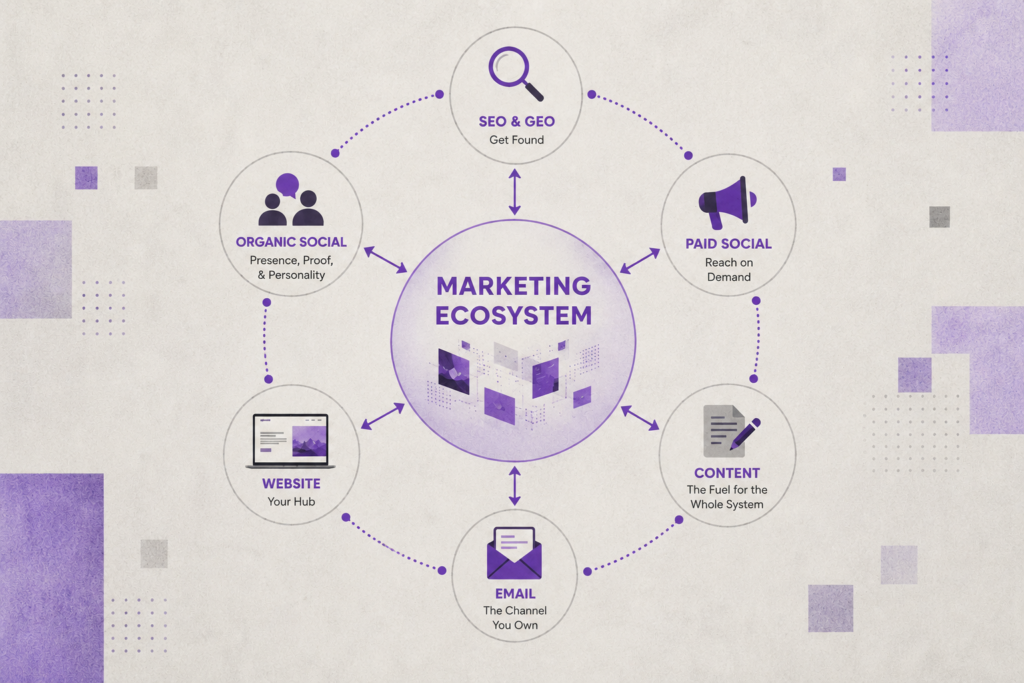
Marketing tactics rarely fail because they’re bad ideas. They fail because they’re working alone.
A beautiful website with no traffic. A strong social presence that sends people to a homepage that doesn’t convert. Great blog content nobody can find. Each channel can look healthy on its own report and still underperform, because marketing isn’t a collection of tactics. It’s an ecosystem, and every piece depends on the others.
Playing it safe in one channel while ignoring the rest is how brands fade into the background. Here’s how the pieces fit together, and why bold brands treat them as one system instead of six separate line items.
The Website: Your Hub, Not Your Brochure
Everything in your marketing ecosystem ultimately points back to one place: your website. It’s the only channel you fully own. Social platforms change their algorithms, ad costs fluctuate, and email deliverability shifts, but your website is yours.
That’s why it has to do more than exist. As a team that designs websites for a living, we’ll say it plainly: a safe, forgettable website is a liability. Your website is where a curious visitor becomes a lead, and that takes bold design that makes people stop scrolling, clear messaging, fast load times, and conversion paths that actually guide people toward taking action, whether that’s filling out a form, requesting a quote, or picking up the phone.
When the hub is strong, every other channel gets more valuable. When it’s weak, you’re paying to send traffic somewhere it goes to die.
SEO and GEO: Getting Found, Today and Tomorrow
Search engine optimization is how your website earns visibility when people are actively looking for what you offer. That means technical health, smart site structure, keyword-informed content, and authority built over time. SEO is a long game, but it compounds. The blog post that ranks well this year keeps delivering leads next year at no additional cost.
But search is changing. More people are getting answers from AI tools and generative search experiences instead of clicking through ten blue links. That’s where GEO, or generative engine optimization, comes in. GEO is about structuring your content so AI-driven search surfaces your brand as the answer: clear, well-organized information, direct answers to real questions, and content that establishes genuine expertise.
The good news? SEO and GEO reinforce each other. Content built to answer real customer questions performs in both worlds.
Organic Social: Presence, Proof, and Personality
Organic social media is where your brand shows up as a living, breathing thing. It’s not primarily a lead generation channel, and treating it like one is where most brands go wrong. Organic social builds familiarity and trust. It’s often the first place a prospect goes to check whether you’re legitimate, active, and worth talking to.
A consistent posting cadence matters more than viral moments, but consistency without personality is just noise. Sharing your expertise, your work, your people, and your actual point of view keeps you top of mind. Brands that are afraid to have an opinion get scrolled past. Brands that show up boldly become the name a follower already knows when they finally need what you sell.
Paid Social: Reach on Demand
Where organic social builds trust slowly, paid social buys reach immediately. Targeted campaigns put your message in front of exactly the audience you want, whether that’s by industry, job title, geography, or behavior.
Paid social works best when it has a job. Lead generation campaigns capture contact information directly. Traffic campaigns drive prospects to a specific landing page. Retargeting campaigns re-engage people who already visited your site but didn’t convert.
And here’s the ecosystem effect: paid social performs better when organic social is active (people click through and see a credible, current page) and when the website destination is built to convert. Ads don’t fix a broken funnel. They just fill it faster.
Email: The Channel You Actually Own
Eblasts and email marketing are often the most underrated piece of the ecosystem. Unlike social followers, your email list is an audience you own outright. No algorithm decides who sees your message.
Email is where you nurture. The prospect who downloaded a resource six months ago, the past client who might need you again, the lead who wasn’t ready to buy yet. Regular, valuable email keeps those relationships warm. And because email drives traffic back to your website, it feeds the hub just like every other channel.
The catch: email only works if you have something worth saying. Which brings us to the engine that powers everything.
Content: The Fuel for the Whole System
Content writing isn’t a channel. It’s the fuel every channel runs on.
One well-written blog post becomes an SEO asset that ranks in search, a GEO asset that AI tools can cite, a week of organic social posts, the destination for a paid campaign, and the centerpiece of your next eblast. That’s five channels powered by one piece of content.
This is why content strategy matters more than content volume. Content built around what your customers actually ask, in a voice that sounds like your brand, does more work across more channels than a high volume of generic posts ever will.
The Ecosystem Effect
Here’s what it looks like when everything is connected:
A prospect discovers your blog post through search. They follow you on LinkedIn and see your posts for a few weeks. A retargeting ad brings them back to your website, where they download a resource and join your email list. Two months later, an eblast lands at exactly the right moment, and they fill out your contact form.
No single channel gets full credit for that lead. Every channel played a part. That’s the ecosystem working.
The takeaway: stop evaluating your marketing channels in isolation. Ask instead whether they’re connected, whether they’re feeding each other, and whether they all lead back to a hub that’s ready to convert. Integration isn’t a nice-to-have. It’s the whole strategy.
Because in a market this crowded, you don’t get points for showing up quietly.

Splendor believes an educated client is our best client. Stay tuned to our blog for insight into the world of everything design, web, and digital media. Have something to add? Connect with us on LinkedIn – we’d love to hear from you.